Offshore operations are entering a defining era of digitalisation. Connectivity, once limited to operational requirements, has become the foundation of how offshore vessels operate, communicate, and evolve. From advanced digital systems and real-time AI analytics to cloud access, videoconferencing, and crew entertainment, modern offshore assets now function as floating digital ecosystems.
Globally, the maritime digitalisation market was valued at approximately USD 175.9 billion in 2023 and is forecast to reach USD 360.7 billion by 2030. In the Middle East and GCC region, this transformation is particularly pronounced, with the MENA maritime digitalisation market estimated at USD 3.3 billion in 2025, of which GCC countries account for around USD 1.4 billion.
In this context, connectivity has evolved from a supporting tool into a strategic asset directly impacting safety, operational efficiency, crew welfare, and competitive positioning. Hybrid offshore connectivity offers a smarter approach to offshore digitalisation by integrating multiple satellite technologies into a unified architecture that balances performance, resilience, and cost control.
While technology is setting the course forward, people remain central to digital transformation. The ability for crews to communicate with family, access digital services, and maintain a sense of normality during long rotations is increasingly regarded as essential to offshore workforce sustainability.
The offshore sector is facing a significant workforce challenge. Industry studies indicate that up to 40% of the current offshore workforce is expected to retire by 2030, while fewer younger professionals are entering offshore roles due to concerns around isolation, long rotations, and work–life balance.
At the same time, Gen Z and Millennials are projected to represent around 72% of the global workforce by 2029. Surveys consistently show that digital access, connectivity, and quality of life now rank among top employment priorities.
In this environment, offshore crew connectivity has become a decisive factor in attraction and retention. Reliable internet access enables offshore personnel to:
By narrowing the experiential gap between offshore and onshore life, connectivity supports wellbeing, morale, and long-term workforce sustainability.
The Middle East is one of the world’s largest hubs for offshore professionals. Across the GCC, national maritime strategies increasingly recognise crew welfare as a prerequisite for a modern and competitive offshore sector.
Initiatives aligned with Saudi Vision 2030 and We the UAE 2031 explicitly link offshore growth to safer, more attractive working environments and acknowledge that human capital is central to maritime resilience and competitiveness.
The offshore maintenance, repair, and operations market is expected to grow from USD 17.84 billion in 2025 to USD 23.73 billion by 2030. This growth is supported by accommodation barge operators, drilling contractors, and offshore support vessel (OSV) operators enabling large-scale offshore projects across platforms, vessels, and remote sites.
This operating model creates a highly mobile workforce, making individual connectivity subscriptions per location impractical and reinforcing the need for integrated, multi-network solutions.
A 2025 Inmarsat survey revealed that while 97% of seafarers actively manage their data consumption, more than 80% still exceed allocated limits, leading to dissatisfaction and rising welfare costs.
The introduction of LEO satellite technology has improved performance but also accelerated data consumption, making it harder for operators to meet expectations while remaining within defined budgets.
Delivering a land-like digital experience offshore, without exposing organisations to uncontrolled connectivity costs, has become one of the sector’s most pressing challenges. No single network can meet offshore requirements for speed, coverage, resilience, and cost efficiency.
Hybrid offshore connectivity combines LEO and GEO satellite technologies within a single, centrally managed architecture. This enables operators to optimise traffic routing, balance performance with predictability, and maintain cost control at scale.
Key advantages include:
For welfare programmes, this ensures consistent crew access without individual pay-per-use models, while enabling operators to maintain governance and budget control.
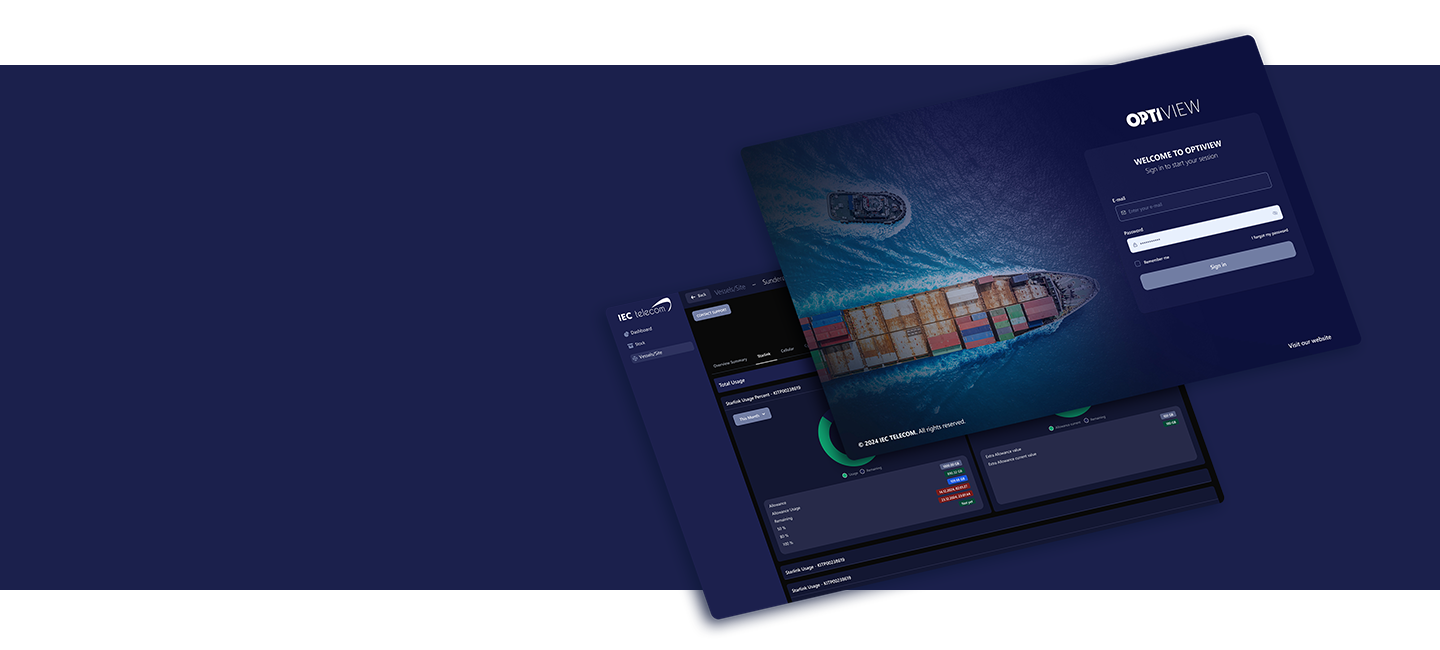
IEC welfare services are built on OptiView, IEC Telecom’s network management ecosystem that underpins the delivery, visibility, and control of hybrid connectivity environments.
OptiView enables:
The platform also integrates OptiShield, IEC Telecom’s cybersecurity module, providing threat protection, vulnerability assessments, and data-loss prevention. Together, these capabilities ensure welfare connectivity remains scalable, secure, and compliant.
Offshore environments demand scalable connectivity frameworks. IEC Telecom’s hybrid architecture enables welfare services to expand across vessels, offshore sites, and accommodation units without network redesign or operational disruption.
Uniform access policies and service quality ensure consistent crew experience across rotating assets, while maintaining security, segmentation, and cost discipline as digital expectations grow.
Hybrid Welfare as a Strategic Advantage
As offshore operations in the Middle East continue to scale in size and complexity, hybrid welfare systems are emerging as a strategic advantage. By combining multiple connectivity technologies within a single intelligent architecture, offshore operators can deliver cost-effective, scalable, and human-centred welfare programmes across multiple sites.