







Predictable
coverage

Established orbits and mature networks deliver stable performance across regional and global beams, with regulatory approvals in place across the markets you operate in
High-performance connectivity over GEO
GEO satellite networks remain the foundation for critical operations worldwide, predictable coverage, stable performance and mature infrastructure that keeps working where terrestrial networks stop. And in a multi-orbit world, GEO VSAT is what guarantees performance: while LEO services share capacity among all users, GEO delivers committed bandwidth with contractual service levels, on its own, or as the assured layer in a hybrid GEO + LEO setup
Established orbits and mature networks deliver stable performance across regional and global beams, with regulatory approvals in place across the markets you operate in
Dedicated bandwidth and committed information rates with clearly defined service levels (SLAs), throughput you can plan operations around, not best-effort speeds.
Ku, Ka and C-Band across leading operators, matched to your sites, routes and availability targets by our engineering team.
Proactive network monitoring, service management and 24/7 technical support behind every deployment, one accountable partner from design to daily operations.
Each band carries a different trade-off between throughput, coverage and weather resilience. Our engineers help you match the right band, or combination, to your requirements.
Every operation weighs guaranteed performance against cost efficiency differently. Our two core models — and fully managed end-to-end options — cover the full spectrum.

Satellite capacity allocated exclusively to your operation. No congestion, no contention, no traffic fluctuations from other subscribers, just predictable throughput and a consistent application experience, backed by defined service levels.

A committed Minimum Information Rate (MIR) that is always yours, with burst access to shared network capacity whenever resources are available. Guaranteed reliability for critical applications — without paying for peak capacity around the clock.
Comprehensive communication solutions for commercial shipping, offshore support vessels, fishing fleets and research vessels, supporting both operations and crew welfare with flexible service management
Best for: Shipping, OSVs, Fishing fleets, Research, Offshore energy
Reliable primary or backup connectivity for remote offices, energy sites, government facilities and humanitarian bases. Dedicated or shared capacity with guaranteed service levels keeps critical applications, VoIP and cloud services running where fibre and cellular don’t reach.
Best for: Energy sites, Government facilities, Humanitarian operations, Remote enterprise, Mining
Continuous connectivity for assets on the move, trains, convoys, emergency-response units and media vehicles. Auto-acquiring antennas and beam-switching keep command, tracking and broadcast applications online across borders and beams.
Best for: Rail & transport, Emergency response, Defence & security, Media & broadcast
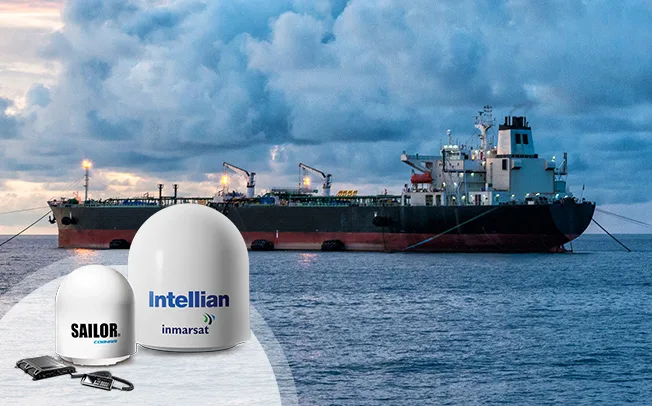
VSAT stands for Very Small Aperture Terminal, a satellite ground station with a compact antenna (typically 0.6–2.4 m) that connects remote sites, vessels and mobile assets to the internet and private networks via geostationary satellites. VSAT provides reliable broadband where terrestrial networks are unavailable or insufficient.
Maritime VSAT is a stabilized VSAT system engineered for vessels. The antenna continuously tracks the satellite while the ship moves, pitches, and rolls, delivering always-on broadband for operations, safety, and crew welfare across oceans , including areas with no coastal network coverage.
The onboard terminal transmits to a geostationary satellite 35,786 km above the equator; the satellite relays traffic to a ground station, which routes it to the internet or a private network. The return path is identical, giving vessels continuous two-way connectivity.
Pricing depends on the band, coverage area, committed bandwidth and service model (dedicated vs shared). Shared services with a committed Minimum Information Rate offer the most cost-efficient entry point; dedicated bandwidth carries a premium for exclusive capacity. Contact us for a tailored quote based on your requirements.
Technically, Starlink terminals are a form of very small aperture terminal, but in the maritime industry "VSAT" conventionally refers to stabilized GEO satellite systems. Starlink is a LEO service with different coverage, latency, and service-level characteristics. Many operators run both: GEO VSAT for guaranteed global coverage, LEO for high-speed capacity where available.
Depending on antenna size, frequency band, and plan, maritime VSAT delivers from a few hundred Kbps up to several tens of Mbps. With optimization software such as OptiConnect, even low-bandwidth links support videoconferencing and telemedicine.
Yes , particularly on Ku- and C-band frequencies, which resist rain fade well. For maximum uptime, IEC Telecom recommends dual-band terminals or hybrid setups with automatic L-band fallback during severe weather.
Yes. Modern hybrid solutions combine VSAT, LEO, and GSM connections in one centralised network management system such as optiview Optiview to automatically routing traffic over the best available network for performance and cost.
Yes, every deployment is backed by proactive network monitoring, service management via OptiView, and 24/7 technical support from our global support centres.