


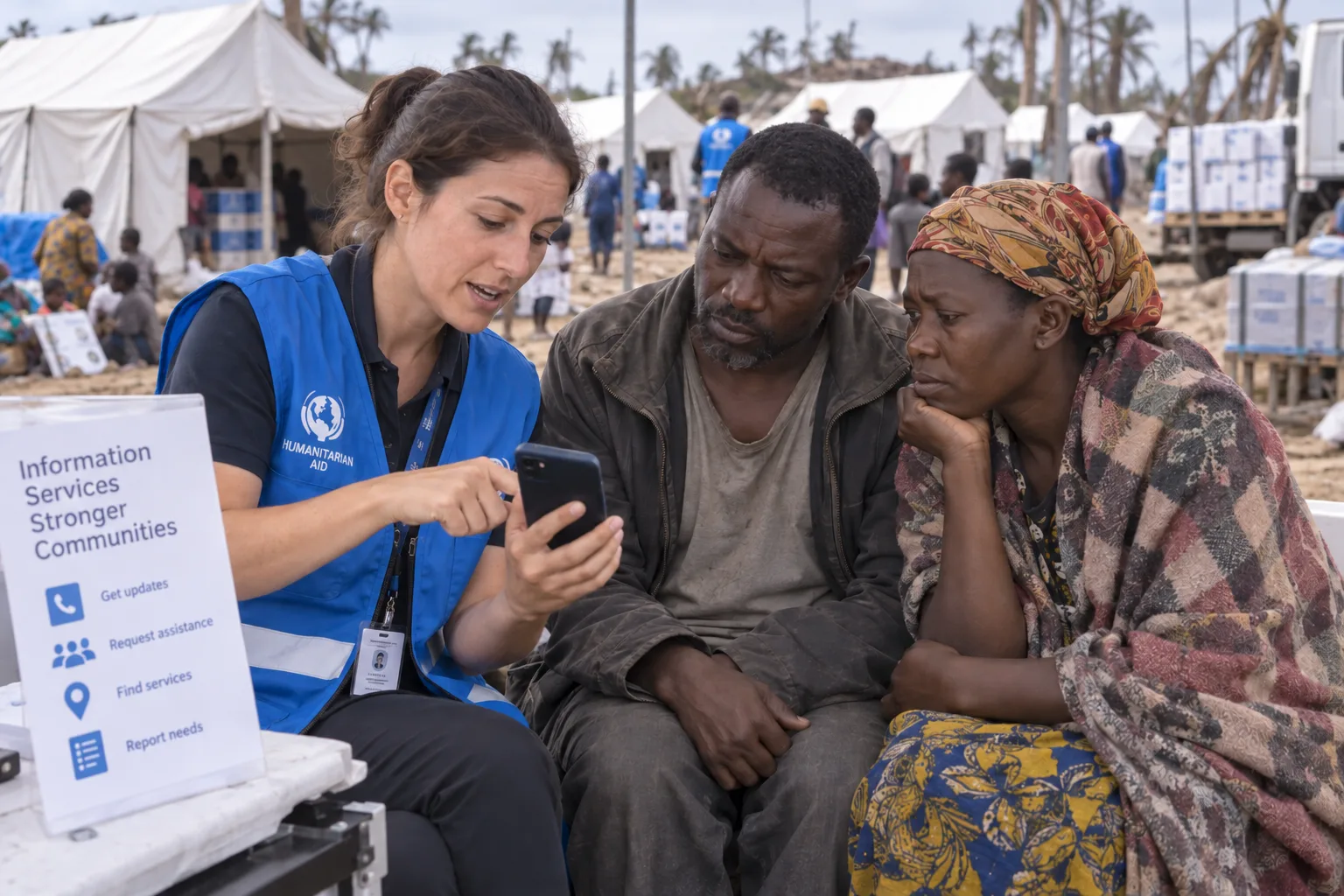
For many people across the Global South, a mobile phone is essential for work, staying in touch with family, and getting important news. When natural disasters like a hurricane, volcano, or an earthquake strike, mobile networks can go down without warning. Along with damage to roads and buildings, people will be cut off from vital information making it harder to stay safe and access essential information and support.
Restoring the connectivity well, not just restoring it fast, is what separates a good response from a chaotic one.
When local networks go down, UN, NGO and civil government teams typically step in. But what they restore rarely matches the capacity that existed before the crisis, so it must be managed carefully from day one. In practice, that means combining bandwidth management, content filtering and basic cybersecurity. Tools like the IEC Voucher Management System and the cybersecurity software OptiShield keep a limited connection that is usable and safe for everyone on it.
Over the past fifteen years, responses have evolved. What began as restoring basic phone access after an earthquake or hurricane has grown into something more structured. Satellite connectivity can now feed full community Wi-Fi hotspots, with rules built in from the start about who gets access, to what content, and for how long. Voucher-based captive portals make this workable in the field, turning the sector’s own bandwidth-management standards into something a team can switch on.
Understanding the Humanitarian Connectivity Model
Deploying emergency communications in a crisis zone takes a structured architecture that turns high-capacity satellite links into manageable, local end-user Wi-Fi:
- Satellite backhaul connectivity: When a disaster cuts underground cables or destroys ground networks, satellite backhaul acts as an emergency internet pipe from space. It connects directly to local Wi-Fi hotspots or surviving cell towers, bypassing damaged ground infrastructure entirely to restore internet access.
- Community Wi-Fi hotspots: wireless access points distribute signal across public spaces, distribution centers, clinics, and temporary shelters.
- Captive portals: the control layer that intercepts incoming device requests, authenticates users, and enforces usage rules.
- Voucher-based access grants individual users targeted, allowance-based access tokens, so use stays fair across the population.
The captive portal is where the real decisions happen. It’s the point where an organisation decides who gets on, what they can reach, and how much bandwidth they are allowed to use.
What a disaster does to the basics:
- Power grids fail in most major disasters, even when telecom towers survive undamaged
- Fuel shortages follow quickly, and generators can’t be resupplied to keep base stations running.
In many rapid disasters, national power supplies will fail. Humanitarian team who deploy to set up connectivity must also provide stable power run the Wi-Fi technology.
The “Do No Harm” Principle and Provider of Last Resort
The international humanitarian sector operates under a strict principle of “Do No Harm.” In telecommunications, UN agencies and international NGOs position themselves strictly as providers of last resort. Shared public connectivity is deployed exclusively where local commercial telecom providers are absent or completely incapacitated, and it is explicitly designed to be temporary.
The objective is never to compete with, replace, or undermine local telecommunications operators, but rather to bridge a dangerous service gap until commercial networks recover and normal service returns.
How the Humanitarian Sector Formalised “Communities First”
In 2015, the Emergency Telecommunications Cluster (ETC) launched its ETC2020 strategy, marking a deliberate pivot from connecting responders only, to also connecting the communities they serve. The Humanitarian sector refers to this as Services to Communities. Two further steps have carried that forward since:
- 2021–2025: ETC2025: consolidates this community-first approach under Pillar 3, Empowered Communities
- 2022–present: Connectivity as Aid (CAA): thirteen jointly agreed standards, backed by technical guidelines, shaping how humanitarian connectivity is planned and delivered today
One of ETC2020’s underlying objectives was building local resilience, so telecom infrastructure could bounce back using resources already in the country rather than relying entirely on outside support.
That concept has since played out in real recoveries.
- After Typhoon Haiyan hit the Philippines in 2013, ETC teams deliberately scaled back their networks as local telecom operators came back online, migrating humanitarian workers onto commercial services rather than keeping the emergency network running indefinitely.
- The same pattern showed up in Dominica after Hurricanes Irma and Maria in 2017: ETC’s shared internet service was withdrawn from Marigot and Roseau as soon as local providers restored their own connectivity, while support continued only in areas still waiting for local services to come back.
A consistent thread runs through all of this: communities need a voice in how their connectivity is designed. That is exactly what Pillar 3 calls for: understanding what people want from a connection, rather than assuming it from a distance, and adapting services to what is affordable, accessible, and usable in that specific context. In practice, which means asking the people who will use a hotspot what content matters most to them, and what should be filtered out, before a captive portal ever goes live.
From Principle to Practice: Managing Bandwidth Under Pressure
Good intentions still need a working system behind them. CAA Standard 11, on reliability, security and quality of services, is where the sector spells this out directly. It calls for a clear approach to bandwidth management, and specifically for what it calls a tiered bandwidth approach.
What the standard actually says:
- Life-saving communications first: Disaster response, such as emergency calls, family tracing, disaster alerts and access to essential safety and health information get bandwidth ahead of everything else
- Tiered bandwidth approach: everything beyond that is rationed by need, the number of users, and how long access is required
- Dynamic allocation: bandwidth adjusts in real time, since a hotspot serving fifty people in the morning might be serving five hundred by evening
A voucher-tiered captive portal is one practical way of putting that approach into practice, designing a system built around the same logic.
What This Looks Like on the Ground: Captive Portal in Practice
In the field, a captive portal acts as the initial digital entry point for anyone connecting to a community network. It accomplishes two vital functions simultaneously: user authentication and the enforcement of tiered access rules.
Using the Captive Portal to Share Critical Information
When a user connects to a managed hotspot, the portal screen can serve as a targeted information board before granting internet access. Instead of routing users directly to generic websites, the portal presents essential local announcements, such as multilingual assistance platforms (such as refugee.info, used widely across refugee responses in Greece and Italy)
Power, Charging Points, and Long-Term Camp Connectivity
In prolonged displacement settings, such as long-term internally displaced person (IDP) or refugee camps where commercial ISPs do not operate, managed Wi-Fi becomes permanent social infrastructure. It powers community communications while simultaneously connecting health clinics, field schools, and administrative centers run by NGOs and local government bodies.
Crucially, because mains electricity is rarely available in these environments, an effective deployment must extend beyond network hardware. Field installations must supply the independent power required to keep the telecoms equipment running continuously, while also incorporating dedicated mobile device charging stations. Without accessible charging points, even the most robust emergency Wi-Fi network remains completely out of reach for people whose phones have run out of battery.
From Standard to System: IEC Voucher Management System
The IEC Voucher Management System translates international humanitarian standards into an operational, field-deployable platform. Designed to give agencies full governance over remote networks, the solution combines centralised oversight with intuitive user access.
The solution is built around two primary components:
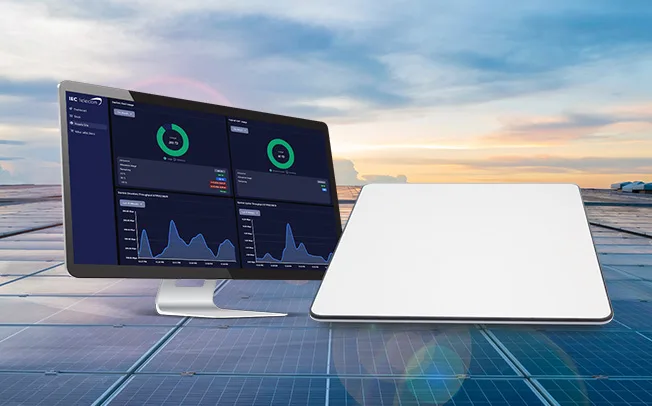
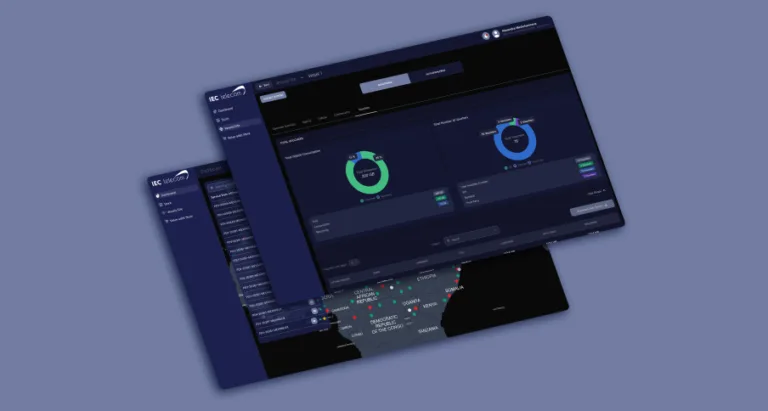
- IEC Voucher Manager (Management Portal): Integrated directly into the OptiView platform, this central dashboard gives ICT managers real-time visibility over user activity, data consumption, and voucher allocations. It enables policy-driven governance across multiple sites, allowing administrators to configure custom access rules, enforce time or volume caps, and manage user categories remotely.
- IEC Social (Captive Portal): The portal end-users see when logging on. It features a dedicated WELFARE tab to activate free corporate or humanitarian allowances, alongside a self-service TOP UP tab for purchasing additional data bundles when needed. The interface is fully customisable, enabling teams to push critical announcements, health advisories, or safety updates directly to user screens at login.
The role of vouchers can also change as the situation stabilises. In the immediate aftermath of a disaster, they can help ration limited bandwidth and ensure fair access. As services become more established, the same system can support subsidised or prepaid access, helping recover some of the ongoing cost of keeping community connectivity available.
Installation and Support
Because these deployments often happen at speed and in places without existing IT infrastructure, the system is backed by global deployment capability and a 24/7 support centre, so field teams have somewhere to turn when something needs fixing at 3am local time, not just during office hours.
Built-in Network Segregation
Most cyber risks and network bottlenecks stem from the uncontrolled use of personal devices. Sitting beneath both portals is strict network segregation, which completely isolates community-facing welfare Wi-Fi from operational networks. This ensures that even if public Wi-Fi encounters heavy traffic congestion or a compromised personal device, mission-critical aid systems remain fully online, secure, and protected.
Advanced Cybersecurity with OptiShield
While basic network segregation handles core safety by default, high-risk or long-term camp environments often demand deeper threat protection. When paired with the IEC Voucher Management System, OptiShield delivers essential protection for humanitarian networks:
- Web Filtering: Blocks malicious sites and high-bandwidth traffic to preserve connection speed.
- Automated Threat Containment: Instantly isolates compromised personal devices to prevent malware from spreading.
- Ransomware Protection: Shields network endpoints from exploits and unauthorized changes.
- Secure Remote Access: Provides encrypted VPN entry with two-factor authentication for field teams.
- 24/7 Response: Supported by around-the-clock expert monitoring and incident mitigation.
From Humanitarian Response to Government Capacity
International relief operations do not work in isolation. UN agencies and NGOs operate exclusively under national government authority, deploying surge capacity only at the host government’s request. While Civil Protection departments lead crisis coordination, international organisations frequently support state healthcare and education services.
As emergency phases end and local networks recover, international providers must step back to avoid displacing local suppliers. However, when camps, clinics, and shelters require ongoing connectivity, the focus shifts to long-term sustainability. Civil governments can take full ownership of these networks, funding and maintaining public Wi-Fi across schools, health centers, and disaster response sites using the same proven principles of controlled access, cybersecurity, and resilient infrastructure.
Looking Ahead
Two shifts worth watching:
- More countries exposed to regular natural disasters now have their own skilled telecom and emergency-response professionals, driving a move toward localising disaster preparedness and response, with local government, communities and the private sector taking on more of the work.
- International humanitarian funding has fallen significantly in recent years, accelerating that same shift toward local ownership
Voucher-based captive portals take a center stage to address this shift. They give humanitarian organisations a way to open connectivity responsibly during the emergency phase, and they give local authorities a system they can eventually take over and sustain themselves.
IEC Telecom works with humanitarian organisations and disaster response teams to plan and deploy managed, secure connectivity for camps, clinics, and community response sites worldwide. Get in touch to talk through what a voucher-managed deployment could look like for your operation.


Build the Right Connectivity Solution
Tell us where you operate and what you need to connect. Our experts will help identify the right solution for your operations.